
The Madraza of Granada: Spain's First University
Founded in 1349 by the Nasrid ruler Yusuf I, the same enlightened monarch responsible for many of the finest additions to the Alhambra, the new madrasa was created to teach theology, law, mathematics, astronomy, medicine and philosophy.
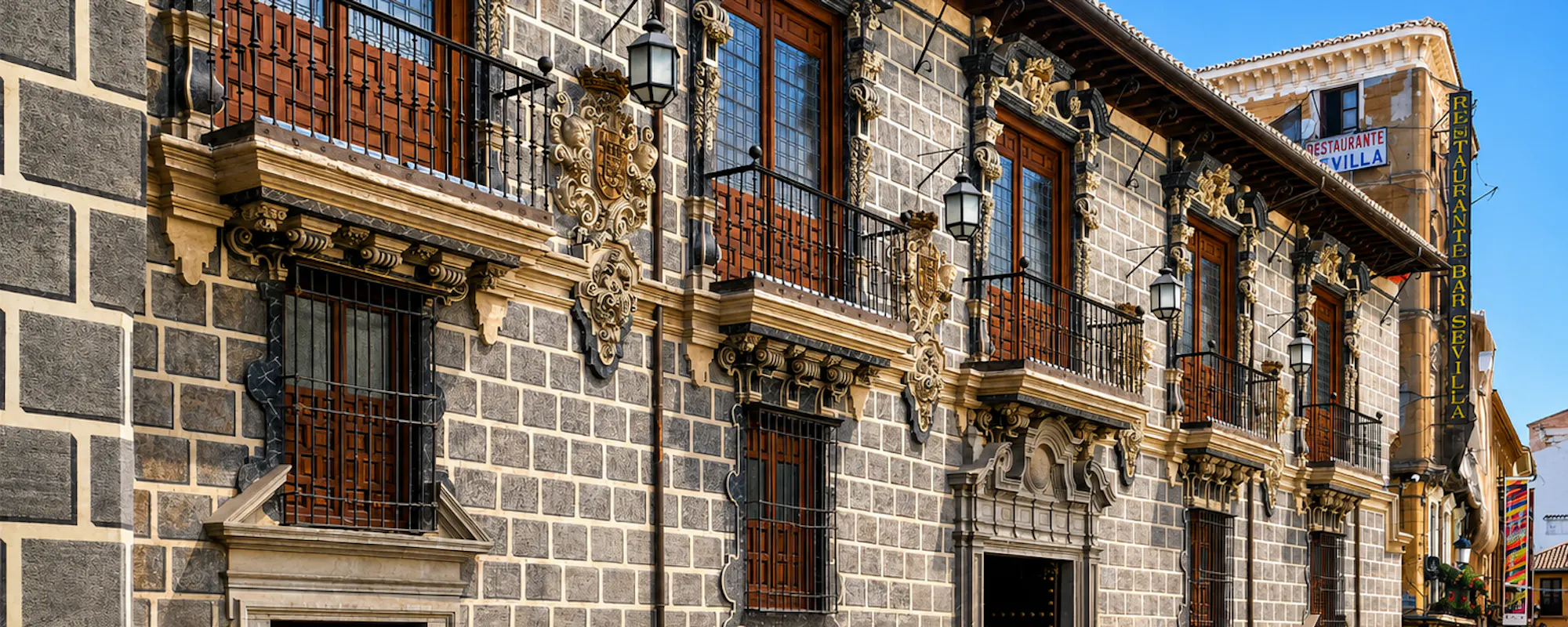
Visitors strolling through Granada's bustling Calle Oficios often pass an elegant Renaissance façade without realising that behind it lies one of the city's oldest and most remarkable institutions. La Madraza, standing only a few steps from the Cathedral and the Royal Chapel, was once the intellectual heart of Nasrid Granada and is widely regarded as the first university established in the Iberian Peninsula under Islamic rule.
Its story mirrors that of Granada itself: a tale of cultural brilliance, conquest, neglect and, ultimately, careful preservation.
La Madraza was founded in 1349 by the Nasrid ruler Yusuf I, the same enlightened monarch responsible for many of the finest additions to the Alhambra. At a time when Granada was one of the great centres of learning in the western Mediterranean, the new madrasa was created to teach theology, law, mathematics, astronomy, medicine and philosophy. Scholars from across Al-Andalus and North Africa gathered within its walls, making the city a centre of scientific and cultural exchange.
Unlike the image many people have of medieval education, the institution was not solely religious. The Islamic world had long valued the study of science and classical knowledge, and La Madraza became a place where intellectual curiosity flourished. Its students would have debated law and literature while also studying subjects that today would be recognised as mathematics and natural science.
The fortunes of the building changed dramatically in 1492 with the Christian conquest of Granada. As the city was transformed, many Islamic institutions disappeared, and La Madraza was no exception. The original university ceased to function, and over the centuries the building served a variety of purposes. It was converted into the Casa del Cabildo, the headquarters of Granada's city council, and many of its Islamic features were altered or concealed beneath later architectural styles.
This process was common throughout Spain. Medieval buildings were frequently adapted rather than demolished, with each generation leaving its own mark. Renaissance and Baroque elements gradually overlaid the original Nasrid structure, preserving parts of the building while simultaneously hiding its earliest identity.
For many years, the significance of La Madraza remained largely forgotten.
Fortunately, changing attitudes towards Spain's Islamic heritage during the nineteenth and twentieth centuries encouraged historians and archaeologists to take a closer interest in the building. Careful investigations uncovered fragments of the original decoration, including the exquisite oratory, or prayer hall, which remains one of the jewels of the complex.
The oratory is a masterpiece of Nasrid craftsmanship. Delicate plasterwork, geometric patterns and Arabic inscriptions survive to this day, providing a rare glimpse into the artistic sophistication of fourteenth-century Granada. Its richly decorated mihrab, indicating the direction of Mecca, is regarded as one of the finest surviving examples of Islamic art outside the Alhambra itself.
Modern conservation efforts have sought not simply to restore the building but to reveal its many historical layers. Architects and historians have worked to preserve both the Islamic and later Christian elements, recognising that La Madraza tells the story of several civilisations rather than one alone.
Today, the building belongs to the University of Granada, which has given it a new educational purpose while respecting its extraordinary past. It serves as a venue for exhibitions, lectures, concerts and academic events, allowing the public to experience a monument that has been dedicated to learning for almost seven centuries.
The preservation of La Madraza is part of a wider effort to protect Granada's unique cultural landscape. Alongside the Alhambra, the Albaicín and the city's historic churches and palaces, it reminds visitors that Granada was shaped by diverse traditions whose influences continue to define the city.
For those exploring Granada, La Madraza offers something different from the great tourist landmarks. It is quieter and less conspicuous, yet in many ways it tells the more profound story. Its walls have witnessed the final flowering of Islamic Spain, the arrival of the Catholic Monarchs, the growth of Renaissance Granada and the modern rediscovery of a shared cultural heritage.
Its greatest achievement may be that it survived at all.
Rather than allowing the past to disappear beneath successive waves of history, Granada has chosen to uncover and protect one of its oldest centres of knowledge. In doing so, La Madraza once again fulfils the purpose for which it was created in 1349: to preserve learning and pass it on to future generations.